My publications
Here are some papers and publications I’ve co-written, as a result of my work and the topics I research.
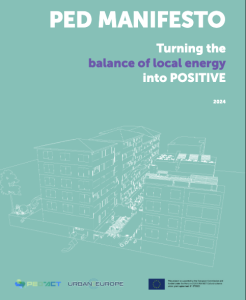
This manifesto outlines a vision for transitioning to Positive Energy Districts (PEDs) through a holistic and inclusive approach. It emphasizes the need for community empowerment, collaboration, and addressing key social, technical, environmental, and governance aspects. The manifesto advocates for essential demands like carbon pricing, public spending on sustainable projects, and prioritizing climate justice. It also encourages immediate actions, such as investing in green energy, participating in energy communities, and advocating for better policies. The ultimate goal is to create sustainable, resilient, and equitable energy districts for the future.
The theory is a result of the participation processes we were engaged in. We came to realize that a crucial part of the energy transition needed to be the active involvement of energy communities.
Reproducing Coercion, examines the structural and psychological parallels between high-pressure groups (cults) and capitalist systems, arguing that both rely on coercion, repetition, and ideological control to strip individuals of agency and perpetuate exploitative hierarchies.
Including theoretical frameworks (including Althusser’s Ideological State Apparatuses, Lifton’s thought reform, and Butler’s performativity), the work dissects how language, ritual, and guilt function as tools to enforce compliance, manufacture insecurity, and naturalize exploitation: in cults as well as in capitalist labor relations.
The thesis identifies sacred science, loaded language, and repetitive labor as core mechanisms by which these systems reproduce themselves, framing practices like prayer, tithing, and workplace discipline as ritualized forms of ideological reproduction.
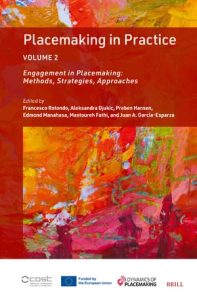
“Youngsters’ Right to the City” is a chapter in “Placemaking in Practice Volume 2” written by Bahanur Nasya, Liridona Ura, Ulrika Stevens, Robert Körner and Yilmaz Vurucu.
The paper focuses on citizen participation, particularly that of youngsters, in urban development and planning.o, we will specifically analyse and evaluate methods that involve playing as a means to encourage young people’s ideas and inspiration. In it, cases are detailed, playing as a tool of engagement is evaluated via experiences in various projects, and the needs of young people in participatory processes is outlined.
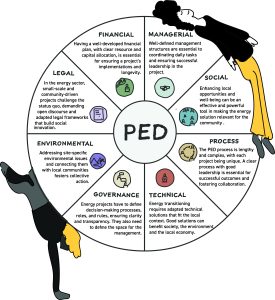
Published in Frontiers in Sustainable cities, the paper outlines the self-scoring system we had developed as part of the PED-ACT project.
A predominant portion of current Positive Energy District (PED) projects focuses on technical advancements, often neglecting non-technical aspects, which can hinder a just energy transition. This raises the question: How can PEDs be assessed to ensure a just, inclusive, and context-sensitive energy transition beyond technical solutions?
Methods: This study develops a cohesive approach that embeds the multiscale, multisectoral, multi-component, and multi-actor nature of PED development. A multi-criteria PED Matrix was created and refined using Natural Language Processing (NLP) and expert feedback to evaluate and benchmark PEDs across eight dimensions: social, governance, technical, process, environmental, legal, financial, and managerial.
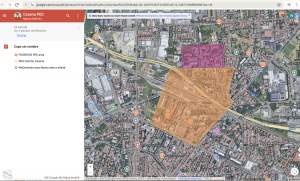
This paper offers an in-depth account of how sustainable initiatives are assembled and function in practice, using the city of Cesena in Northern Italy as a case study. Located along the Savio River, Cesena’s cultural identity and urban development have long been shaped by its close relationship with the river and its surrounding biodiversity. This connection, however, has been increasingly tested by environmental crises, most notably the devastating flood that severely impacted the region in 2023. In response, the project aims to establish a collaborative public–private governance scheme that fosters closer cooperation between local residents, municipal authorities, and key stakeholders.
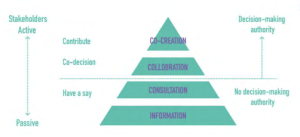
Presented at the ISOCARP conference in Toronto in 2023 and published in volume 1, this paper outlines how most energy transition projects have been
concentrating on technical aspects, with the implemented projects not fully reaching a net positive output throughout the year. The paper discusses methods and ways of involving citizens and communities in the pathways of PEDs.