About
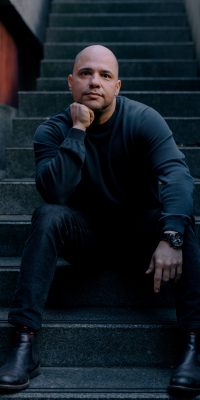
My journey has been one of navigating the fringes and existing in the in-betweens: between cultures, systems, and beliefs. I once thought I was alone and my experiences were uncommon. Being the “outsider” shaped a perspective rooted in skepticism of the common (and the system), alongside a commitment to struggling outsiders.
Unable to complete my bachelors at Temple University (another recurring theme of my journey: incomplete education and the desire to overcome this), I moved to Istanbul and began working at local TV stations there. Realizing the exploitative reality of the industry, and the difficulty of life in general (and having my wind knocked out of me as I tried to exist alone, with little to no support network in a megapolis of that size) I moved back to Canada and back in with my family.
The next few decades would see me work in Canadian TV, in various capacities, including writer, producer and director – mostly of promotional and short advertising content.
At a certain point in my career, I began feeling the futility of it all, and wanted to rekindle my love of the art form I had studied vigorously during my incomplete bachelor’s.
So I took the plunge, and decided to create. Though, looking back, I can see my drive was unmatched by my know-how and knowledge: another recurring theme in my life (having to “catch up” with the knowledge possessed by my peers). Together with Bahanur, we would later joke about being “late bloomers” due to the distance we had to cover and re-learn.
I applied for grants, wrote scripts, and collaborated on projects, determined to reclaim creative agency.
My first film, Dr. Zack, was about a disadvantaged young boy trying to make sense of the world and achieve something meaningful, only to have his world collapse under the weight of systems he couldn’t defeat.
That cynicism stayed with me. Through x-arts, the non-profit Bahanur and I founded as a hub for creation and networking, I wrote and directed other shorts: Gematria, Sweet Candy, and The Sea in Me (documentary), each a critique of systemic failures in their own way.
Meanwhile, thanks to Bahanur, I connected with a different reality: communities and collaborations. Wonderland, a network of architects and creatives, was active in social issues, workshops, and integrating communities as sources of valid knowledge rather than subjects of top-down planning.
As I navigated life in Vienna, learning German and finding my footing (I had decided to move here, and found myself on the outskirts of society yet again), I discovered new ways of creating, communicating, and existing.
Through x-arts, I found my way towards documenting community initiatives and exploring themes like social inclusion, transforming the built environment through arts, and the intersection of ecology and community.
I also began developing my own little network, applied for EU funding with partners from various EU countries. And we received some application approvals. How about that.
We worked on Erasmus projects such as Parking Day for fitness (which transformed urban spaces into areas for physical activity), BioYOUToon, a project using comics to raise awareness about biodiversity, and CHAC, where participants in Vienna researched the history of the Sandleiten area in Ottakring and created artworks for a final exhibition, became central to this work. Additionally, the Art and Nature Walks project, which brought together youth from various countries to Vienna to explore natural landscapes and create a public mural in Floridsdorf, further deepened my engagement with participatory and ecological practices.
After years of attempting to complete my undergraduate degree and applying to institutions in Austria to no avail (guess bureaucracy has no solution for the uniquely uncommon), I had found Primorska University in Koper, Slovenia through an acquaintance (the wonderland network – thank you Bostjan).
The university allowed me to transfer some credits from Temple from decades ago, and complete my studies by finishing the remaining credits – which i what I would’ve loved to happen in Vienna. Regardless, I finally earned a bachelor’s in Media Studies. Thing is – I had a chip on my shoulder regarding formal education, and felt the need to prove I could accomplish obtaining higher degrees.
On recommendation, I applied for the Critical Studies master’s program at the Fine Arts Academy in Vienna – and lemme tell you, this study really changed how I do things. I began seeing the value in context, critical approaches, systemic questioning and building on existing knowledge. It introduced me to concepts such as artistic based research, Nepantla writing, and validated my life experience. The program was godsend for me – even though I was an outsider (once again) due to my age, I fit in with the others because the group was a unique and eclectic group of curious, inquisitive, artists seeking to explore knowledge and build means of expression. My “rough” edges were smoothed: i realized exploration was a perfectly valid form of self-expression and I wasn’t obligated to have all the answers or develop a definitive result within a restricted time period. Exploration and seeking knowledge was a valid form of work and labour.
My master’s thesis, “Reproducing Coercion: An Exploration of the Reproduction of Ideology in Cults and Capitalism,” delved into the parallels between capitalism’s historical structures and coercive groups. I examined how ideology is reproduced, how class-based societies mirror cult-like dynamics, and how Ideological State Apparatuses reinforce exploitation and its internalization—a theme that runs through much of my work.
This brings me to the final piece of my puzzle: Wonderland. Through it, I’ve been deeply involved in EU-funded projects like POSEIDON, which focuses on re-imagining mobility systems through community-led solutions, and Fair Mobility, where we challenge extractive models by centering equitable access to resources and decision-making. In Fair Mobility, we developed frameworks for inclusive transportation, emphasizing the need for systems that prioritize social justice, ecological sustainability, and community agency. Our work highlights how participatory design and Urban Living Labs can transform mobility into a tool for empowerment rather than exclusion. I also co-authored the PED Manifesto with Wonderland, a document I’m particularly proud of, as it places communities at the center of transitions toward just and sustainable futures.
The manifesto argues for a shift from top-down planning to collaborative, bottom-up processes that honor local knowledge and collective agency.
But there’s more…
About a year and a half ago, I met a researcher, Kristina Pfeifer in person. She had already written a book and produced a documentary on the Yörük nomads of Türkiye—a topic I was beginning to engage with for two reasons. Personally, it resonated with my own obscured Yörük heritage, a part of my identity I had only begun to explore. Professionally, I was increasingly drawn to alternative lifestyles and existences outside the overwhelming norms of the Capitalocene.
Trips to Türkiye, particularly to Başaran, Olukbaşı, and Aydınlı, deepened this connection. There, I witnessed firsthand the Yörük way of life and a metabolic relationship with the land, seasonal migrations, and communal knowledge systems that resist the homogenizing pressures of modernity. Their existence, threatened by privatization, ecological degradation, and forced sedentarization, embodies both resilience and precarity.
Today, Kristina and I are creating a documentary and applying for funding to spend months with the Yörük during their Göç. Our plan is to accompany them in order to document and preserve what remains of their endangered way of life, while exploring and interweaving personal reflections on the political, economic and social issues around the topic of alternative lifestyles in the Capitalocene.
That’s my journey in a nutshell: from disillusionment to active engagement, from skepticism to co-creation, and from the fringes to the heart of communities resisting erasure.