Our research is a work in progress: an unfolding, continuously assembled and developed artistic research project.
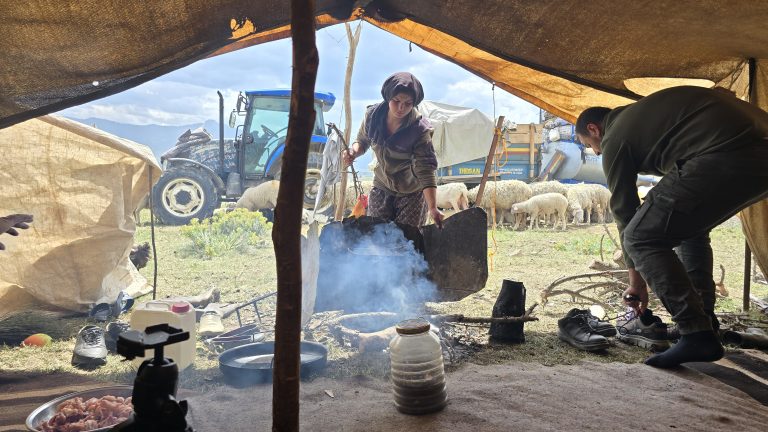
As Anatolia’s Yörük nomads struggle to preserve their endangered material culture, ecological knowledge, and social structures amid modernization, forced sedentarisation, climate‑driven instability, and resource extraction, we attempt to understand their practices from within their own conceptual world. We approach Yörük knowledge not as folklore to be collected, but as valid scientific and epistemic input, engaging through co‑creation, shared decision-making, and relational trust.
Our aim is to explore how Yörük material production techniques, social relations, seasonal knowledge, and economic practices persist, transform, or vanish under the pressures of the Capitalocene, a concept that highlights (within the framework of this project) capitalism’s systemic reorganization of ecology, labour, relations, and space.
For the Yörük, this manifests in many ways. A loss of material culture, as production techniques become impossible to sustain and the natural materials they once relied on disappear from use or production. A loss of sociality, as communal structures built on sharing, intergenerational exchange, and mutual responsibility struggle to survive under the growing weight of precarity and individualism that shape both their lives and ours. A loss of pathways, as ecological change alters pastures and seasonal rhythms, and as privatization and ownership carve ancestral routes into fragments and restrict mobility. And finally, a loss of meaning, as the stories, concepts, and vocabularies that once shaped Yörük identity fade with the passing of elders or are gradually displaced by the demands and adaptations of settled life.
The capitalocene
A loss of pathways, as ecological change alters pastures and seasonal rhythms, and as privatization and ownership carve ancestral routes into fragments and restrict mobility. And finally, a loss of meaning, as the stories, concepts, and vocabularies that once shaped Yörük identity fade with the passing of elders or are gradually displaced by the demands and adaptations of settled life. The Capitalocene thus produces a shrinking world, leaving less space for nomadic mobility and the metabolic balance that sustains it.
The project also reflects on how the Yörük’s historically rooted metabolism with nature (reciprocal, regenerative) is being fractured by the expanding demands of capitalist extraction. Their tent‑making, goat‑hair weaving, herding practices, and seasonal organisation embody a metabolic configuration fundamentally misaligned with the intensifying extractive logic of the present. As privatized land, industrial materials, and ecological degradation encroach on their territories, the rift widens, leaving their balanced relationship with the environment increasingly untenable.
The Göç
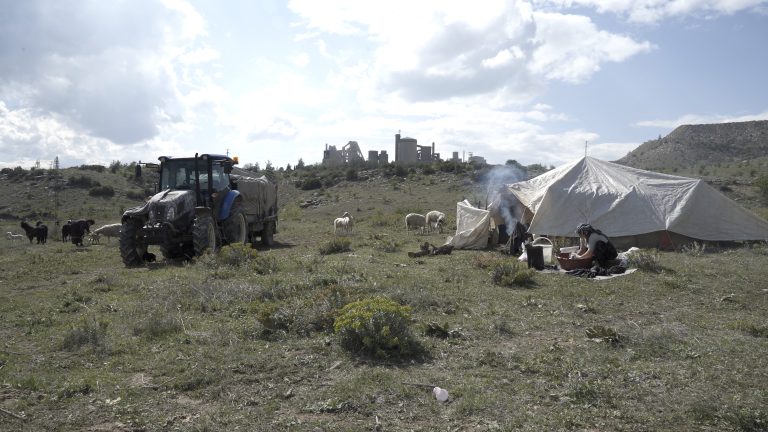
Yörük migration routes are increasingly under threat. Once stretching across Anatolia’s mountains and valleys, these pathways, which were carved by generations of nomadic knowledge, are now fragmented by privatization, industrial expansion, and settler infrastructures. The Aydinli Family camped at this site for a few days in Spring of 2025, on their migration route. The camp and make-shift tent stands in stark contrast to the permanent structures of extraction behind it. This juxtaposition is not just spatial but metaphysical: a clash between a metabolic way of life rooted in cyclical mobility and the linear, extractive demands of the Capitalocene. The Yörük struggle to maintain their routes is a struggle to preserve an alternative worldview which treats land as a public resource and knowledge as lived commons.
Göç was and remains the center of Yörük life. It describes the physical act of seasonal migration and the entire rhythm through which Yörük existence becomes meaningful. Families move with their goats, camels, and sheep (as well as themselves and their goods) across a wide geography. This allows the animals to graze without exhausting any single pasture. The movement was slow and responsive. The animals stayed long enough to sustain themselves but not long enough to imbalance the environment. In this way, Göç was a form of ecological intelligence and a lived interpretation of balance, reciprocity, and care.
Their tents, their stories, their production techniques and relations as well as the way they understood themselves were all shaped through Göç. It created the conditions for their sociality, their material culture, and their seasonal orientation toward the land. As contemporary pressures unsettle these movements and shrink their pathways, the meaning of Göç itself becomes fragile. What remains is both memory and practice; memory held together through testimonies and stories (which we’re attempting to capture) and practice through adaptation to new material realities.
Tent weaving
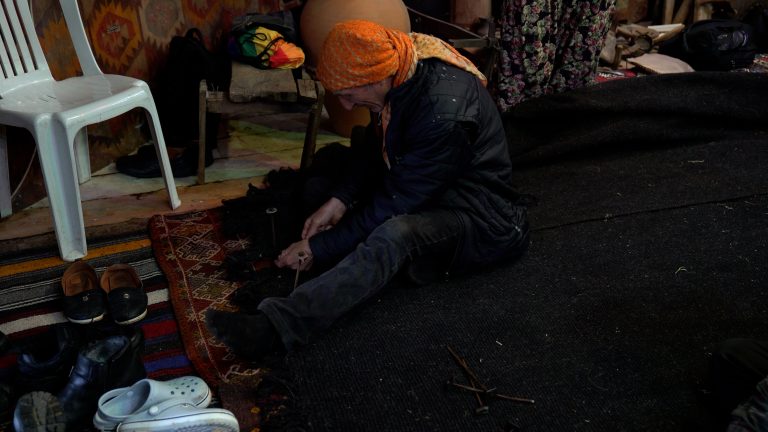
This video offers an incomplete, early gathering of voices and practices around Yörük tent weaving and the techniques that sustain it. We plan to continue expanding these encounters regarding the material production techniques of the Yörük.
Tent weaving is an integral part of Yörük material life. It binds ecological intelligence, social organisation, and intergenerational memory into a single, continuous practice. Goat-hair is spun, twisted, and woven into panels that serve as a unique technology suitable for Yörük life, becoming tents that remain cool in the summer, warm in the winter, and waterproof when raining.
The tents also act as a central location. Together with the fire lit in the middle, they serve as the communal gathering point, eating place and space for exchange among generations. It is in these tents that the Yörük learn and produce, communicate and share developments, situate and grasp.
As we continue to work with tent makers and weavers across Ahmetli, Olukbaşı, and Denizli, our intention is not to document technique as an isolated object. We seek to understand weaving as a living relation that ties people to the land, to each other, and to histories that are at risk of being forgotten.
Resilience
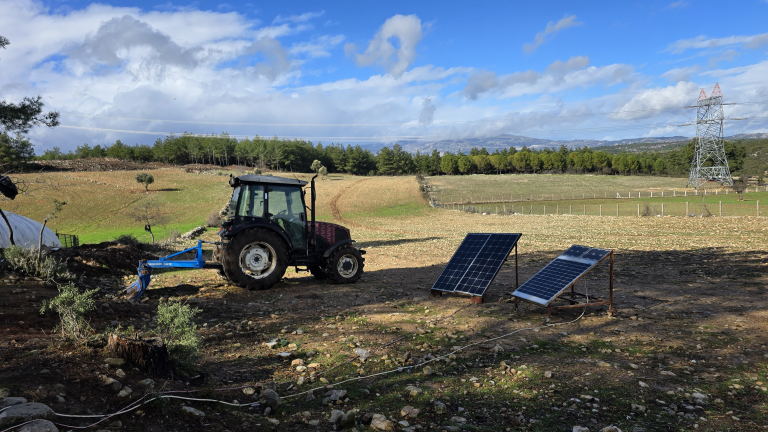
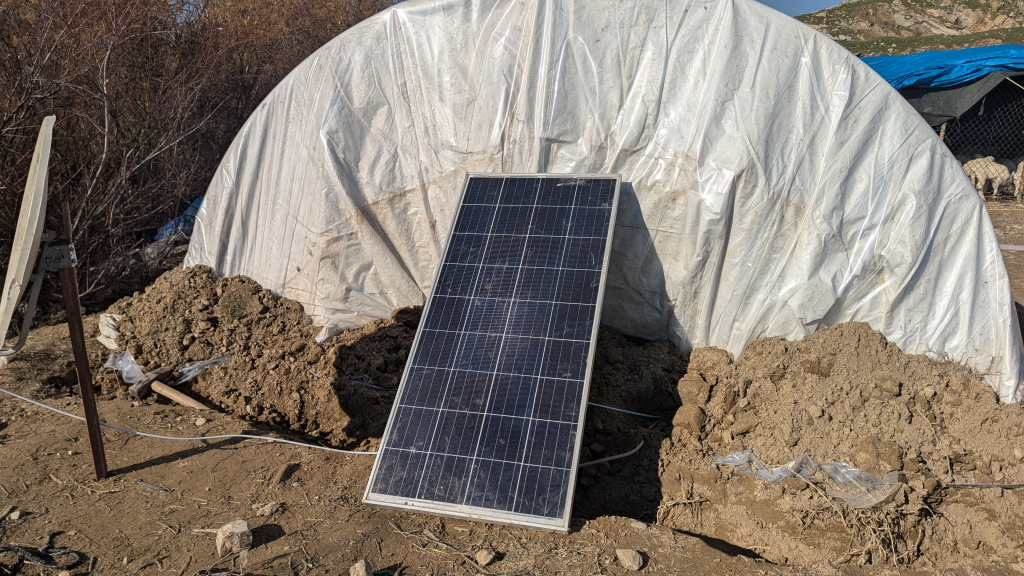
The two photos (from the Sürücü and Aydinli winter camp sites) capture the essence of Yörük resilience: a solar panel powering a tent. Technology and tradition coexist without contradiction. The Yörük are pragmatic survivors, masters of blending ancestral knowledge and customs with modern tools to sustain their way of life. The tent, still the heart of their world, now makes use of the quiet energy of photovoltaic cells. In Yatagan (Muğla), Ayşe and Ali Sürücü’s family revealed to us that they bring a fridge to their summer camp, plugging it into solar power when needed. As we sat in the tent to discuss and exchange, we noticed their granddaughter playing games on a tablet. They all have android phones and follow their favorite social media channels: for the older generation, this consists of wildlife videos and fellow Yörük videos. In Denizli, as seen in the photo the aydinli make use of technology to provide them with amnenities.
a recent development: reconnection
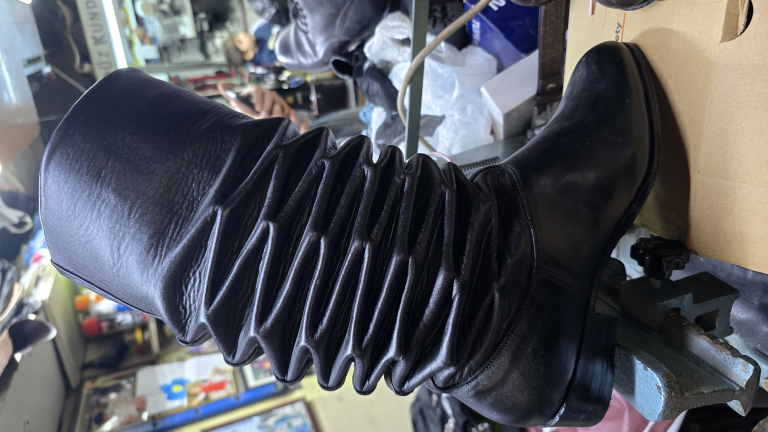
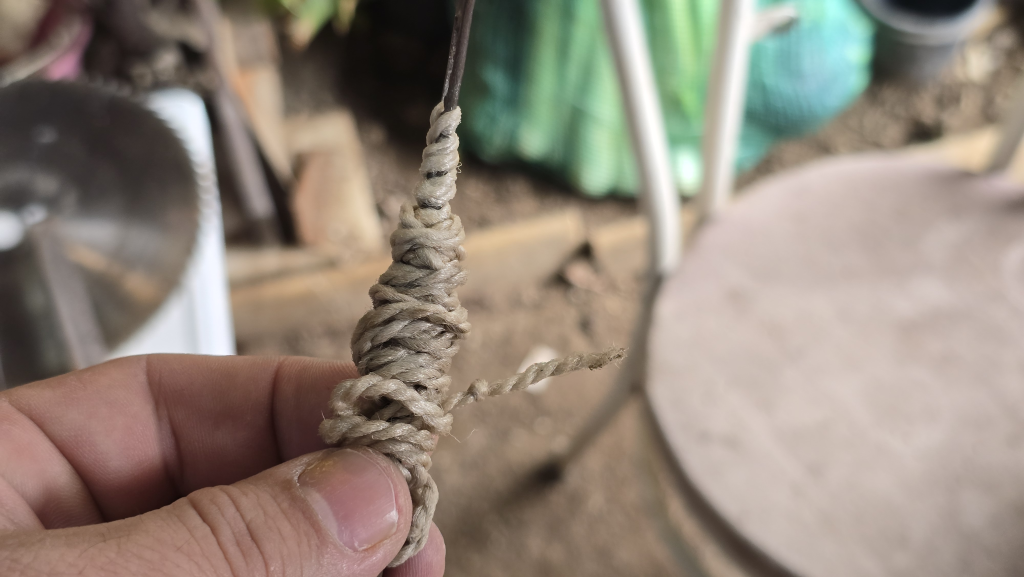
Second and third-generation Yörük settled Yörük, now living in cities like Denizli and Aydın, are quietly re-establishing ties to their nomadic past. With financial stability comes the space to revisit what was once necessary, now a choice. The first image shows a needle, once carried in the brim of a Yörük man’s hat, ready to mend a torn tent flap or stitch a frayed textile on the move. The tool served as extension of their mobility, a solution always at hand. The second is a pair of Yörük boots (known as “körüklü cizme”), their stitching and shape honed over centuries for durability on rocky paths. Few makers remain, but the craftsman we met in Aydın has made it his mission to keep the knowledge alive. For him, and for those returning to these traditions, the attempt is a way of reclaiming a connection to their past and identity.
Research Methodology
Our research combines ethnographic research with reflexivity and standpoint: we continuously situate the knowledge shared with us within broader questions of global exploitation, and the historical marginalisation of mobile peoples, as well as with our own perceptions and experiences. Yörük are valuable dispensers of unique and important knowledge in this research, as such we learn from them and listen to them.
Yilmaz Vurucu, MA contributes with artistic research techniques and his practice of filmmaking, complimented by a personal history shaped by a partially obscured Yörük past, which guides his attention toward lived experience, narrative, and the emotional dimensions of cultural erosion. Dr. Pfeifer brings extensive knowledge of weaving and tent making, along with years of close collaboration with Yörük communities, as an expert who has studied and written about Yörük material production techniques (as well as culture) for over a decade. Together, they work not as observers but as partners, approaching Yörük practices as legitimate forms of knowledge and inviting co-creation wherever possible.
Methods include participant observation, filming, embodied presence, and non‑formal interviewing techniques that allow stories to emerge at their own pace. Yörük elders often share knowledge only after trust is established; withholding is equally meaningful; silence as story, signalling histories of displacement, political risk, or ongoing surveillance. Community collaboration anchors the process: co‑creation, joint interpretation of materials, and shared authorship ensure that the research resists extractive tendencies.
Spanning communities in Ahmetli (Izmir), Kuyucak (Aydin), Başaran (Denizli), and Yatağan (Muğla), and extending to fully nomadic tribes in the Taurus Mountains, the project aims to trace the spectrum of adaptation and precarity within a rapidly constricting world. Through artistic and ethnographic practices, we follow how Yörük knowledge systems illuminate alternative ways of living and being, offering counter-models to the homogenizing forces of the Anthropocene and the extractive demands of the Capitalocene.
So far, we have conducted interviews, documented production techniques, and established wider contacts within the community. We’re looking forward to building on this network and expanding our work to encompass a documentation and reflection on the lives of the remaining nomadic Yörük tribes. As said in the introduction: the images and videos below are but the initial findings. We will continue to deepend our research over the course of the next few years.